
 Home
Home JLJL33 Login
 Live Casino
 Slots
Slots Fish game
 Sports
 Promotion
 App
App News
NewsWhat is Short Deck Poker, and why has it become such a hot topic among poker players worldwide in recent years? In fact, it’s a special variation of traditional poker, offering a faster pace, greater volatility, and strategic decisions requiring completely different thinking compared to Texas Hold’em. Not only is it popular in international poker tournaments, but Short Deck Poker (also known as Six Plus Hold’em) is also considered a version suited to modern playing trends: short, dramatic games with lots of action and minimal passive play. Let’s explore it with JLJL33!
What is Short Deck Poker?

Short Deck Poker, also known as Six Plus Hold’em, is a variation of Texas Hold’em but uses a shortened deck of only 36 cards. Accordingly, cards from 2 to 5 are completely removed, leaving only cards from 6 to Ace (A).
This simplification of the card count significantly changes the probability of each hand combination appearing, leading to adjustments in hand rankings and playing strategies. Therefore, even with a background in Texas Hold’em, Short Deck Poker players must adapt to this new mindset if they want to be effective.
The name “Short Deck” comes directly from the fact that the deck is shorter than usual. Cutting 16 cards makes each hand more intense, with a higher chance of hitting cards and more frequent all-in situations compared to traditional poker.
What’s different about hand rankings in Short Deck Poker?
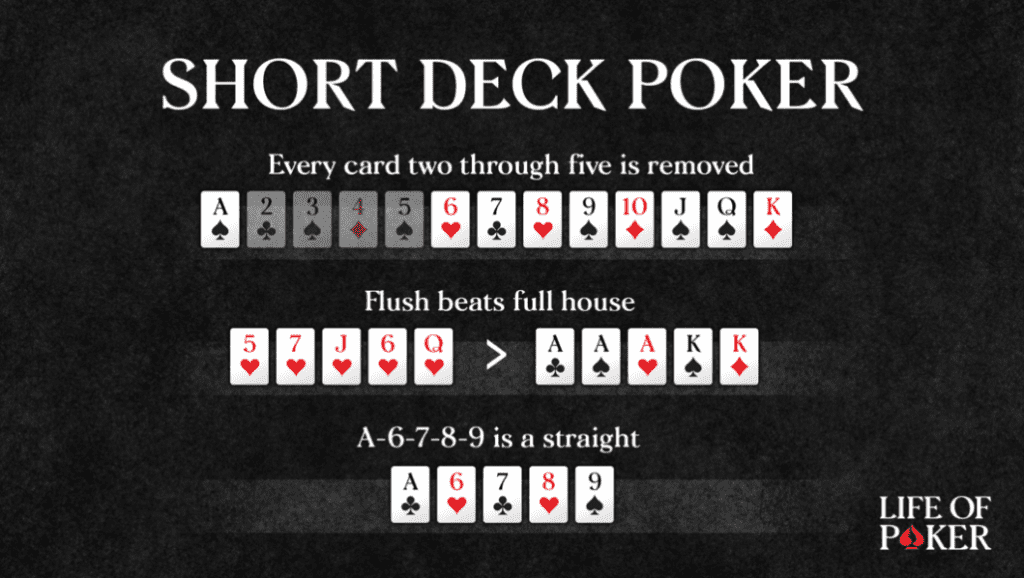
One of the most important points when understanding what Short Deck Poker is is the change in the ranking of hand combinations. Due to the reduced number of cards, the probability of certain hands appearing also changes, leading to the following adjustments in hand strength:
Flush is ranked higher than Full House due to the significantly reduced probability of creating a Flush.
Three of a Kind is stronger than Straight.
The lowest straight in Short Deck Poker is A – 6 – 7 – 8 – 9, where the Ace can be considered the lowest card.
Misunderstanding hand rankings is a common mistake for newcomers switching from Texas Hold’em to Short Deck Poker, and is also a reason why many lose quickly, even with seemingly strong hands.
Detailed Short Deck Poker Rules
Overall, Short Deck Poker retains the familiar structure of Texas Hold’em with four main betting rounds. However, the initial betting method and pace of play have some important differences.
First Betting Round (Pre-Flop)
Before the cards are dealt, all players must place an ante bet. Additionally, the button position will place an extra ante bet, replacing the small blind and big blind system in Texas Hold’em.
Then, each player is dealt two private cards (hole cards), and three community cards are placed face down in the middle of the table. Actions begin clockwise.
In this round, players can choose:
- Call: Match the current bet
- Raise: Increase the bet
- Fold: Fold
Note: There is no Check option in the first betting round. All players must decide whether or not to bet.
Second Betting Round (Flop)
The first three community cards are face up. Players combine their hole cards with the community cards to assess the strength of their hand.
From this round onwards, the Check option applies. Players can:
- Check if no one has bet yet
- Bet if they want to open betting
- Call, Raise, or Fold depending on the situation
- The first player to act is the player to the left of the button.
Third Round (Turn)
Those familiar with Sunwin poker share that the fourth community card is revealed. This is a highly decisive round because the probability of completing a hand becomes clearer.
The strategy in the Turn round of Short Deck Poker is usually aggressive due to the higher equity of the hands compared to traditional poker.
Final Round (River)
The fifth and final community card is revealed. Players complete the strongest 5-card hand.
After the final round, if two or more players are remaining, all cards are revealed for comparison. The strongest hand, according to the Short Deck Poker ranking, wins.
Effective Short Deck Poker Strategies
Due to the short deck size, Short Deck Poker strategies differ significantly from Texas Hold’em. Players need to adjust their thinking to avoid falling into probability traps.
- Prioritize strong hands from the Pre-Flop, especially AX and high pairs.
- Play slowly and selectively to trap opponents instead of bluffing repeatedly.
- Don’t overestimate your Flush; compare it to the opponent’s chances of having a Straight or Full House.
- Manage your bankroll carefully due to high volatility and frequent all-in bets.
- Observe your opponents’ betting behavior to read their hands, as Short Deck Poker is more about action than defense.